Low voltage, high voltage and solar panels in motor vehicles
Updated information
12V and Solar Installations in Vehicles and Trailers
This page reflects the updated V2-2026 guidance covering electrical installations, battery installation and photovoltaic arrays.
01
Electrical Installations
Electrical installations must comply with Australian Standard AS 3001, Electrical installations - Movable premises (including caravans) and their site installations, and must be inspected by a licensed electrical contractor under NSW Fair Trading requirements.
02
Batteries
Batteries must be rechargeable and have a minimum capacity of 40Ah at a 20-hour discharge rate.
Battery securing must allow no more than 25mm of movement under a pulling force equal to twice the battery weight. A clearance of 300mm must be maintained around battery terminals from metallic services, unless appropriate shielding or terminal covers are provided.
Lead-Acid Batteries
These requirements apply to all lead-acid battery types, including sealed, maintenance-free, gel and AGM batteries.
External installations: The battery must be open to the environment with a spill tray, or installed in a battery compartment with a spill tray and ventilation. Ventilation must prevent gases from entering the habitable area.
Internal installations: The battery must be in an enclosed battery compartment with a spill tray. The battery or compartment must be vented to the exterior by an approved method, such as a battery venting kit, an upper vent tube, or high-level and low-level exterior vents.
The compartment must be protected against acid-laden gases. If it opens into the vehicle interior, its lid must seal the compartment from the habitable area.
Lithium-Ion Batteries
Lithium-ion batteries must be installed outside the habitable area, or behind a wall, compartment, enclosure or barrier that prevents gases from entering the habitable area.
Installation must remain within the manufacturer's temperature and IP-rating limits. A suitable battery container is required where the cells are not already encapsulated.
Compartment design and any required venting must be determined from the battery manufacturer or supplier, taking account of battery chemistry, construction and thermal-runaway behaviour.
The battery may be installed in a fully sealed enclosure or in a compartment vented to the outside atmosphere where required by the manufacturer or considered necessary for the installation.
A generic upper and lower vent requirement should not be stated for every lithium battery unless required by the manufacturer or the specific installation design.
Each battery must have a battery management safety system that monitors voltage, current and temperature and automatically disconnects under critical conditions. A visible battery monitor must display state of charge.
03
Solar
Solar installations must comply with AS/NZS 5033 and AS/NZS 3001. Where an installation does not exceed 60 volts DC or 35.4 volts AC, it is low voltage and does not require certification by a licensed electrical contractor through a CCEW. A normal 12-volt or 24-volt automotive system is recommended.
04
Recreational and Movable Structures - Low Voltage
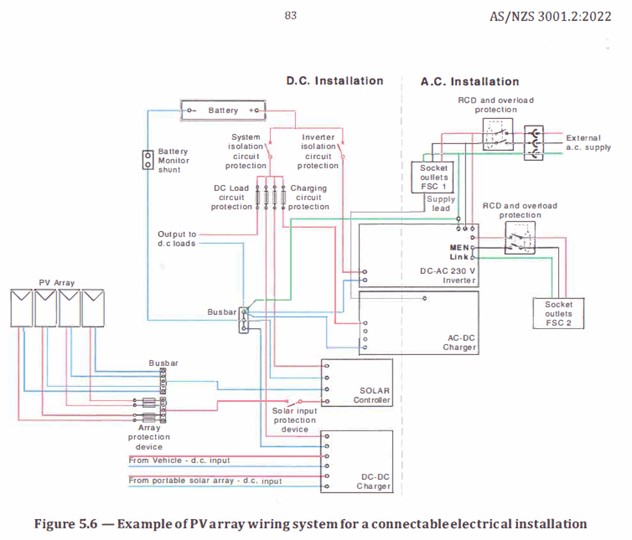
Solar panels are referred to as PV (photovoltaic) arrays. Each array requires individual overload and short-circuit protection using adequately voltage-rated fuses separately installed on its power side. An input protection device, using manual switching rather than an automatic isolator, must be installed between the regulator and the PV array fuses.
Before the current AS/NZS 3001:2022 standard, the two wires from a solar array would normally have been connected directly to the solar regulator.
Applies to
All vehicles with mounted low-voltage solar-panel installations, including 12-volt systems in motorhomes, four-wheel-drive vehicles, goods vehicles, passenger vehicles, heavy vehicles and caravans.