


Tyre Size Calculator
Compare original and proposed tyre dimensions with a live, proportional visual.

Compare tyre sizes
Enter the size moulded on each tyre. Each tyre can use Metric, Inches or a verified Other catalogue size independently, and the results update automatically.
Please enter a valid value in every field.
Overall diameter change
The proposed tyre is larger in overall diameter.
Tyre Size Comparison Visualizer
Tyre width difference: +50.0 mm (+21.28%)
Speedometer Error
Assuming the speedometer is calibrated to the original tyre size.
| Indicated | 10 | 30 | 50 | 70 | 90 | 110 | 130 | 150 km/h |
|---|---|---|---|---|---|---|---|---|
| Actual | 10.3 | 30.9 | 51.5 | 72.2 | 92.8 | 113.4 | 134.0 | 154.6 km/h |
Calculation Results
| Measurement | Original Size 235/85R16 | New Size 285/70R17 |
|---|---|---|
| Overall Diameter (mm) | 806 | 831 |
| Overall Diameter (in) | 31.73 | 32.71 |
| Sidewall Height (mm) | 200 | 200 |
| Sidewall Height (in) | 7.86 | 7.85 |
| Tread Width (mm) | 235 | 285 |
| Tread Width (in) | 9.25 | 11.22 |
| Difference | 0 mm (0.00%) | +25 mm (+3.10%) |
Summary millimetre values are rounded to the nearest whole millimetre. The additional results below retain decimal precision.
Additional Results
| Measurement | Original | Proposed | Difference |
|---|---|---|---|
| Overall diameter | 805.9 mm / 31.73 in | 830.8 mm / 32.71 in | +24.9 mm (+3.09%) |
| Sidewall height | 199.8 mm / 7.86 in | 199.5 mm / 7.85 in | -0.3 mm (-0.13%) |
| Section width | 235.0 mm / 9.25 in | 285.0 mm / 11.22 in | +50.0 mm (+21.28%) |
| Rim diameter | 406.4 mm / 16 in | 431.8 mm / 17 in | +25.4 mm (+6.25%) |
| Circumference | 2531.8 mm | 2610.0 mm | +78.2 mm (+3.09%) |
| Revolutions per kilometre | 395.0 | 383.1 | -11.8 (-3.00%) |
| Ride-height change | Half the overall-diameter change | +12.5 mm | |
| Actual speed at indicated 100 km/h | Assuming the speedometer is calibrated to the original tyre | 103.1 km/h (+3.1 km/h) | |
Wheel Track and Position Calculator
Compare the original and proposed rim widths and offsets. Track measures between wheel centrelines. The initial calculation assumes unchanged hubs.
Enter valid tyre section widths, rim widths, offsets and wheel tracks.
Rim and tyre edge measurements
Across the axle, edge to edge. Tyre width is nominal section width; the tyre is not drawn in the position view.
- Rim inside to inside
- —
- Rim outside to outside
- —
- Tyre inside to inside
- —
- Tyre outside to outside
- —
- Rim inside to inside
- —
- Rim outside to outside
- —
- Tyre inside to inside
- —
- Tyre outside to outside
- —
With Lock off, enter the known proposed / current wheel track to calculate the required wheel offset, or enter a proposed wheel offset to calculate the resulting track. Both calculations use Original specifications and assume unchanged hubs. Track = original track + 2 × (original offset − proposed offset). Offset = original offset − (proposed track − original track) ÷ 2. Tick Lock to hold the proposed track and shade the Wheel offset field as read-only; the track field itself remains editable. Uncheck Lock to edit Wheel offset again. Rim width affects inner clearance and outward projection, not wheel-centre track. Original specifications remain independent inputs.
Important: This is a geometric wheel calculation, not a compliance determination. Confirm the applicable wheel-track limits and measure the vehicle before certification.
Tyre Cold Inflation Calculator
Estimate cold pressure for each loaded axle using the tyre size above, its sidewall markings and published load–inflation data.
PSI–kPa converter
1 psi = 6.89476 kPa • 1 kPa = 0.145038 psi
kg–lb (pounds) converter
1 kg = 2.20462 lb • 1 lb = 0.453592 kg
Using the load–inflation tables
- Use the original or proposed size above, or enter another tyre size. Confirm the tyre type and load index on the sidewall. For dual tyres, use the dual index. Add each axle in a tandem group individually.
- Use the heavier axle end when known. With only an axle total, the calculation assumes equal left and right loads.
- For replacement tyres, determine the original tyre capacity at the placard pressure. Enter it per axle end so the lookup uses the greater of that capacity and the load at the heavier end.
- Enter the vehicle pressure floor and the lowest applicable maximum. The lookup selects the first available published pressure step that carries the load within those limits.
For an unlisted fitment, use the exact tyre manufacturer’s table and enter its values in the published units. Confirm the correct single or dual row and any required load or speed adjustments for the application.
Important: These are load–inflation estimates. Confirm the tyre’s application, the vehicle placard or approved specification, and the tyre and rim limits before setting road-use pressure.
Offset and Backspacing
Wheel offset is the distance in millimetres between the wheel centreline and the hub-mounting face. Positive offset generally positions more of the wheel inward; negative offset generally moves it outward. Zero offset places the mounting face on the centreline.
Backspacing is measured from the wheel's rear outer edge to the hub-mounting face. More backspacing places more wheel inside the wheel arch; less backspacing moves it outward.
Marked wheel width is the bead-seat width, not overall outside width. This calculator uses the common approximation of nominal width plus 1 inch. Measure the actual overall rim width when an exact result is required.
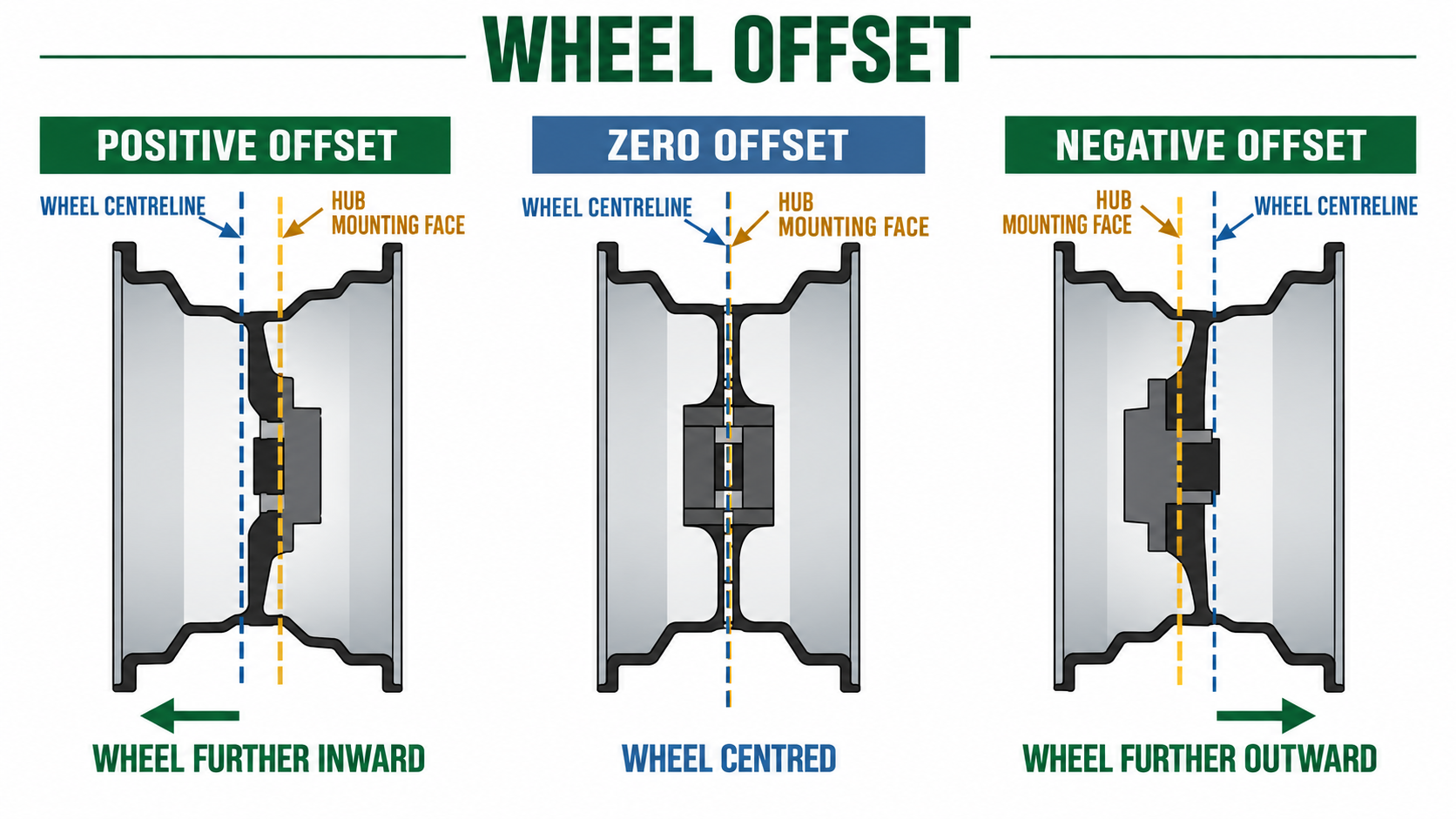
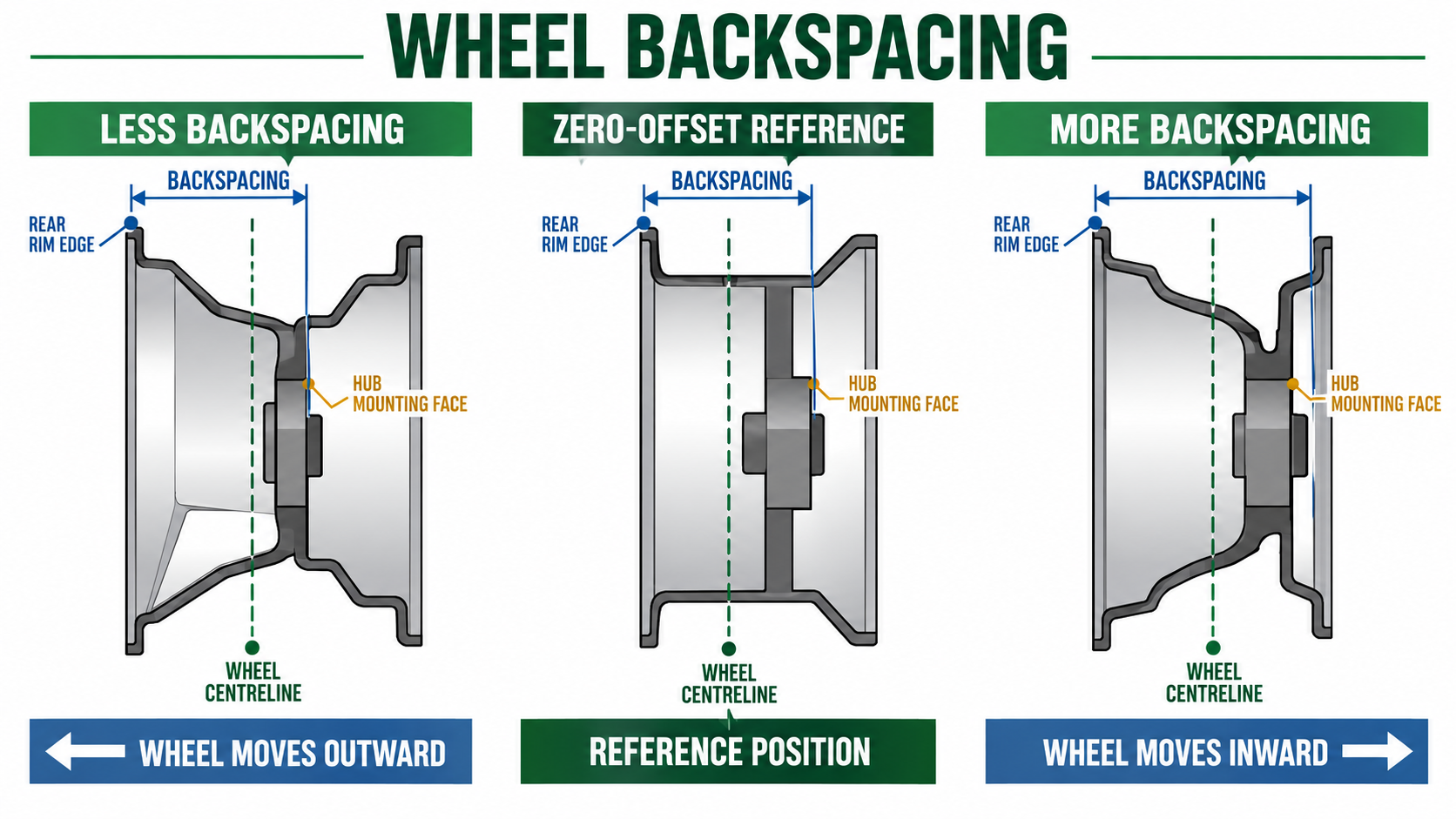
Offset and Backspacing Calculator
Backspacing = overall width ÷ 2 + offset ÷ 25.4 • Offset = (backspacing − overall width ÷ 2) × 25.4
Important: Wheel fitment must also account for tyre section width, approved rim width, brake and suspension clearance, steering movement, body clearance, load rating and applicable track requirements.
Drivetrain, Differential Ratio and RPM Calculator
Drivetrain, Differential Ratio and RPM Calculator
Uses the Original and Proposed tyre sizes entered above. Select a category and common ratio, or enter any known ratio directly. Presets are selection aids, not confirmation of axle fitment or availability.
Theoretical steady-state values assume no clutch or torque-converter slip. Nominal tyre circumference is used unless measured rolling circumference is entered. Tailshaft RPM refers to the shaft between the final reduction/transfer case and axle; it does not establish safe shaft speed. Enter the total final-drive reduction for hub-reduction axles.
Wheel RPM = km/h × 1,000,000 ÷ (60 × circumference in mm). Tailshaft RPM = wheel RPM × final-drive ratio. Engine RPM = tailshaft RPM × transmission ratio × transfer ratio. Enter engine-specific operating ranges; these are not automatic economy or towing recommendations.
Tyre Load Index Table
View load index table
Load Index Table
Example:
Tyre 295/80R22.5 G358 152/148 L
- 152 – is the load index for single axle that corresponds to a maximum load of 3,550 kg, an air pressure of 125 Lbs (according to air pressure table), and to a maximum speed of L=120 km/h.
- 148 – is the load index for a tandem axle that corresponds to a maximum load of 3,150 kg, an air pressure of 125 Lbs (according to air pressure table), and to a maximum speed of L=120 km/h.
| LI | kg | LI | kg | LI | kg | LI | kg | LI | kg | LI | kg | LI | kg | LI | kg | LI | kg | LI | kg |
|---|---|---|---|---|---|---|---|---|---|---|---|---|---|---|---|---|---|---|---|
| 80 | 450 | 100 | 800 | 120 | 1,400 | 140 | 2,500 | 160 | 4,500 | 180 | 8,000 | 200 | 14,000 | 220 | 25,000 | 240 | 45,000 | 260 | 80,000 |
| 81 | 462 | 101 | 825 | 121 | 1,450 | 141 | 2,575 | 161 | 4,625 | 181 | 8,250 | 201 | 14,500 | 221 | 25,750 | 241 | 46,250 | 261 | 82,500 |
| 82 | 475 | 102 | 850 | 122 | 1,500 | 142 | 2,650 | 162 | 4,750 | 182 | 8,500 | 202 | 15,000 | 222 | 26,500 | 242 | 47,500 | 262 | 85,000 |
| 83 | 487 | 103 | 875 | 123 | 1,550 | 143 | 2,725 | 163 | 4,875 | 183 | 8,750 | 203 | 15,500 | 223 | 27,250 | 243 | 48,750 | 263 | 87,500 |
| 84 | 500 | 104 | 900 | 124 | 1,600 | 144 | 2,800 | 164 | 5,000 | 184 | 9,000 | 204 | 16,000 | 224 | 28,000 | 244 | 50,000 | 264 | 90,000 |
| 85 | 515 | 105 | 925 | 125 | 1,650 | 145 | 2,900 | 165 | 5,150 | 185 | 9,250 | 205 | 16,500 | 225 | 29,000 | 245 | 51,500 | 265 | 92,500 |
| 86 | 530 | 106 | 950 | 126 | 1,700 | 146 | 3,000 | 166 | 5,300 | 186 | 9,500 | 206 | 17,000 | 226 | 30,000 | 246 | 53,000 | 266 | 95,000 |
| 87 | 545 | 107 | 975 | 127 | 1,750 | 147 | 3,075 | 167 | 5,450 | 187 | 9,750 | 207 | 17,500 | 227 | 30,750 | 247 | 54,500 | 267 | 97,500 |
| 88 | 560 | 108 | 1,000 | 128 | 1,800 | 148 | 3,150 | 168 | 5,600 | 188 | 10,000 | 208 | 18,000 | 228 | 31,500 | 248 | 56,000 | 268 | 100,000 |
| 89 | 580 | 109 | 1,030 | 129 | 1,850 | 149 | 3,250 | 169 | 5,800 | 189 | 10,300 | 209 | 18,500 | 229 | 32,500 | 249 | 58,000 | 269 | 103,000 |
| 90 | 600 | 110 | 1,060 | 130 | 1,900 | 150 | 3,350 | 170 | 6,000 | 190 | 10,600 | 210 | 19,000 | 230 | 33,500 | 250 | 60,000 | 270 | 106,000 |
| 91 | 615 | 111 | 1,090 | 131 | 1,950 | 151 | 3,450 | 171 | 6,150 | 191 | 10,900 | 211 | 19,500 | 231 | 34,500 | 251 | 61,500 | 271 | 109,000 |
| 92 | 630 | 112 | 1,120 | 132 | 2,000 | 152 | 3,550 | 172 | 6,300 | 192 | 11,200 | 212 | 20,000 | 232 | 35,500 | 252 | 63,000 | 272 | 112,000 |
| 93 | 650 | 113 | 1,150 | 133 | 2,060 | 153 | 3,650 | 173 | 6,500 | 193 | 11,500 | 213 | 20,600 | 233 | 36,500 | 253 | 65,000 | 273 | 115,000 |
| 94 | 670 | 114 | 1,180 | 134 | 2,120 | 154 | 3,750 | 174 | 6,700 | 194 | 11,800 | 214 | 21,200 | 234 | 37,500 | 254 | 67,000 | 274 | 118,000 |
| 95 | 690 | 115 | 1,215 | 135 | 2,180 | 155 | 3,875 | 175 | 6,900 | 195 | 12,150 | 215 | 21,800 | 235 | 38,750 | 255 | 69,000 | 275 | 121,500 |
| 96 | 710 | 116 | 1,250 | 136 | 2,240 | 156 | 4,000 | 176 | 7,100 | 196 | 12,500 | 216 | 22,400 | 236 | 40,000 | 256 | 71,000 | 276 | 125,000 |
| 97 | 730 | 117 | 1,285 | 137 | 2,300 | 157 | 4,125 | 177 | 7,300 | 197 | 12,850 | 217 | 23,000 | 237 | 41,250 | 257 | 73,000 | 277 | 128,500 |
| 98 | 750 | 118 | 1,320 | 138 | 2,360 | 158 | 4,250 | 178 | 7,500 | 198 | 13,200 | 218 | 23,600 | 238 | 42,500 | 258 | 75,000 | 278 | 132,000 |
| 99 | 775 | 119 | 1,360 | 139 | 2,430 | 159 | 4,375 | 179 | 7,750 | 199 | 13,600 | 219 | 24,300 | 239 | 43,750 | 259 | 77,500 | 279 | 136,000 |
Scroll horizontally to view the complete table on smaller screens.
Load-index capacities align with the internationally used LI scale, including UNECE Regulation No. 54 commercial-tyre data and the higher specialist range published in ISO 4250-1.